Atriad Press
Atriad Press was founded in 2002 by a group of principle partners with extensive backgrounds in the writing and publishing industry. Together, they brought together decades of experience with the common goal of establishing a publishing house that will provide high-quality, enjoyable books to the reading public.
For a number of years this was the Atriad Press website.
Content is from the site's archived pages.
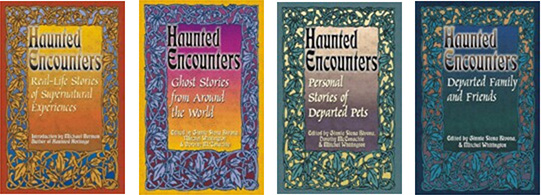
We decided to start with a series of books that would have the appeal of books like Chicken Soup For the Soul series, and the Cup Of Comfort series…these books stay in print, back list sales go on for years, and the possibilities for new versions are unlimited.
Based on prior experience, we knew that ghost stories sold, and sold well! We decided to do something new…real-life experiences, told by the person who lived them. We checked major bookstores and Amazon, and were delighted to find there were no comparable books available. There are many ghost books, but they are all about travel, old ghost tales, or regional stories. Few were about individual experiences, narrated by the actual observer, and no books included writers from all over the world. Many of our writers are from Canada and England, as well as Ireland, Scotland, Wales, Italy, Germany, India, Japan, the Philippines, Australia, New Zealand and even Turkey(and adding more every day,) thereby greatly expanding our market reach.
The first release from Atriad Press was Haunted Encounters: Real-Life Stories of Supernatural Experiences. The book featured forty-six true accounts of interactions with the spirit world from people all across the United States, and around the world. We now have four books in the series in print, and two more ready to go to press, as well as several more in the submissions stage.
Selection of stories for all Haunted Encounters books take place in a very appropriate setting: a haunted house! Submissions are all spread out in the front parlor of the 150 year old home, and the painstaking process is begun among the spirits that reside there. So far, none have shown up for the voting, at least that could be seen!
Now we are proud to be adding books for two more very popular niche markets, History, and Sports. In the future we intend to develop books aimed at the Boomers, and to enter the Regional market with books for Texas non-fiction readers. This is a seriously underserved market where the staff of Atriad Press is especially noted for it’s expertise.
Contact Us!
Ginnie Bivona: ginnie@atriadpress.com
Mitchel Whitington: editor@atriadpress.com
Atriad Press LLC
13820 Methuen Green
Dallas, TX 75240
(972) 671-0002
Everyone loves a ghost story...
Especially when it's told by the person who actually experienced it!
Each book in the Haunted Encounters series is a collection of true stories of the supernatural, told first-hand by the people who lived them.
"Although these fine ghost collections can be purchased separately, they are so entertaining and enjoyable it is suggested they be purchased together for the home library, or as a gift for a friend. Well-edited, they will attract many paranormal readers with their keen insights and unusual happenings."
- Lee Prosser, Ghostvillage.com
"In the mood for a ghost story or two? Then you've come to the right place - the Haunted Encounters series of books features ghost stories on every topic that you can imagine, sweeping around the world from almost every continent in the globe. Ghosts manifest themselves in many different ways, and the Haunted Encounters series is full of varied experiences."
- ParanormalGhost.com
"It’s books like these that answer the question as to why so many people are fascinated with ghosts and hauntings - this series offers chilling compilations of strange experiences and will keep you turning the pages long into the night! The compelling collection takes on modern accounts of ghosts, from typical encounters with restless spirits to truly unique brushes with the unknown. Ghost book authors like Mitchel Whitington, Docia Schultz Williams, Olyve Hallmark Abbott and others, join ranks with typical people like those who live on your block and pass along first-hand accounts of ghosts. These are must-have books that will be great additions to your collection!"
- Haunted America
HAUNTED BOOKS
The book that started it all:
Haunted Encounters: Real Life Stories of Supernatural Experiences
Forty-six stories from many countries, each with one thing in common - true supernatural experiences, told by the very people that actually lived them. This book is a must read for anyone who enjoys a good ghost story... because these are all true!
Haunted Encounters: Ghost Stories from Around the World
Countries from every corner of the globe, all sharing a common thread: Ghosts! This book brings together 48 tales from people around the world. The authors will take you through each story in their own words: their thoughts, their feelings, and the spirits who crossed over into their lives.
Haunted Encounters: Personal Stories of Departed Pets
Not every spirit belongs to that of a human being - sometimes, a beloved pet who has passed on returns to comfort their master, or just to say "I'm okay". These stories are true encounters with the spirits of dogs, cats, horses, and many more animals who have come back for a visit from the other side.
Haunted Encounters: Departed Family and Friends
Some of the most emotional ghost stories involve family and friends who have departed from us in death, but pay an occasional visit to those who loved them most. This book will give you a tear on one page and a chuckle on the next as you share the intimate stories with the people who actually had the experiences. Although this is a book of ghost stories, it is a celebration of the lives of these departed family and friends - both the one that they had on Earth, and the one that continues on in another realm.
And watch for more Haunted Encounters books coming in 2007..
OTHER HAUNTED BOOKS
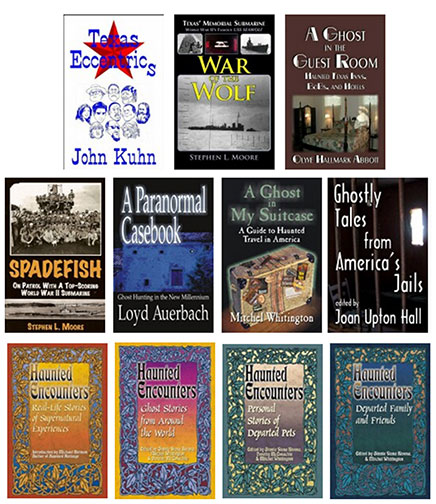
A Paranormal Casebook: Ghost Hunting in the New Millennium
Loyd Auerbach, Director of the Office of Paranormal Inestigations, has been investigating cases of apparations, hauntings, and poltergeists for over a quarter century. In his latest book, you will read tales such as the case of the peeping-Tom ghost, strange footsteps in an attic, the water-tossing poltergeist, and the ghost who likes to party.
Loyd Auerbach is one of the longest running veterans in the paranormal investigation field and his experience really shines through in this book. I like the extra detail and candor that he puts into his stories - you come away with the feeling that Mr. Auerbach is someone that you can trust.
Examples of this extra detail are many. My favorite is the mysterious matron who is a clean crazy demon. She covets a hidden stash of some unknown, but valuable commodity related to her bathroom. And the clues abound: there's a broom that suggests a witch, a mop a wizard. The toilet seat is always up even though she's the only one who uses it, and there's a humongous amount of different toilet tissue brands that the author suggests might have been used, yet stashed in a closet. It's toilet tissue, not on a roll, and there's no dispenser, so things get a bit haywire during the electrical storm that showers sparks through the bathroom window because you see, this toilet tissue is unusually flammable...
One of the most fascinating and original stories is about a pilot whose plane was seen, heard and cited by the FAA for exceeding noise levels. The problem is that the incident occurred six hours AFTER the pilot's death - and the plane was in a museum! The case files also begin with a summary prologue of the activity reported before the team went on site; which can aid in diagnosing phenomena of your own by comparing 'symptoms'. Mr. Auerbach also has some strong insights into the nature of ghosts and how investigations should be conducted."
- Society for Paranormal Investigation
A Ghost In The Guest Room
Scoop up a Texas map and plan an itinerary for a hauntingly fun visit to the Inns, B&Bs, and Hotels found in this book. So much of early Texas history lingers in these lovingly restored hostelries, along with a long-term resident ghost or two. Thoughtfully divided into seven regions, there's a place nearby, or one on your way to wherever you may want to go. Author Olyve Abbott has traveled the entire state seeking out firsthand reports of hauntings, mysterious occurrences and tales of the just plain unexplainable, and she recounts it all in this entertaining read. Be prepared for anything; from a puff of smoke following you down the hall, to a guest you didn't expect joining you late at night. And should a lady in a polka-dot dress ask for directions to Room 36, don't be surprised when she disappears before you can answer her. If the paranormal intrigues you, these are the places you'll be most likely to find it.
++++
Our current requirements are for a series of books on supernatural happenings focused on the State of Texas. The first two titles in this series are:
True Tales of Texas Ghosts: Living in a Haunted House
True Tales of Texas Ghosts: Spirits in the Workplace
Submission Guidelines for True Tales of Texas Ghosts
- EXTREMELY IMPORTANT: Please be sure to include as much contact information with your submission as possible. We have literally had to pull stories that were selected for some of the books because we only had an email address for an author, and it became unreachable.
- To be considered for publication, a submission should be based on a true, supernatural encounter that you have personally experienced in the State of Texas.
- Length requirements are somewhat flexible, but stories should be 1000-2000 words. Longer stories will be considered. Submissions under 1000 words will not be accepted.
- Please note that this series features Texas supernatural encounters with ghosts, spirits, etc. Stories regarding monsters, aliens, angels, or any non-ghostly entities are not appropriate for this series.
- Stories should be written on an adult level, but please keep in mind that the series is marketed to school libraries as well. Stories containing extreme violence, explicit sexual content, strong language, or any other elements that makes them inappropriate for a teenaged audience cannot be considered.
- Photos relating to the story will be considered, although are not required. Please send story without photos initially, but note what photos are available to accompany it.
- An author bio is required to accompany a story that has been selected for publication. You may use this bio to promote your other work, your website, etc. We would also appreciate a photo to run with the bio.
- Please be sure to double-check the grammar in your stories. Although we're looking for content, grammar does make an impression on the initial read. Also, there's no need to put two spaces between sentences - one space is preferred. A good way to check your story is to read it aloud.
- Stories can be submitted by postal mail or email, although electronic submissions are preferred. Email submissions can either be as text in the body of the email, or as an attached file in Microsoft Word (*.doc), text (*.txt), or Rich Text Format (*.rtf). Manuscripts received by postal mail cannot be returned
- True Tales of Texas Ghosts is a series of books, each with a different theme. A submission that is not selected for one volume may be very appropriate for another. Please understand that a delay in a story's acceptance is not necessarily a rejection.
- Stories may be edited as deemed necessary to suit the format of the book. The story's author will be contacted for approval if substantial changes are required.
- If selected for publication, the author grants rights to the story to the publisher for as long as the book remains in print. To further use the story in print or other media, please contact Atriad Press for prior approval.
- There is no limit to the number of stories that an author can submit. Authors may submit more than one story for each book, and can submit stories for different titles.
- Writers selected for this collection of personal ghost tales will be paid $25.00 upon publication, and will receive a copy of the book in which their story appears. More importantly, authors can purchase additional copies of the books at discounted prices, and re-sell them at book signings, speaking engagements, etc. for additional revenue. A photo and brief bio of the author will be included at the end of the story.
- Please note that publication dates may change due to the volume of stories received or unforeseen market factors. If Atriad Press is accepting stories for one or two particular volumes of True Tales of Texas Ghosts, but an unforeseen large number of stories are received that fit into an unscheduled volume, that unscheduled book may be moved up in publication. Please be patient if you do not get an immediate response to your submission. If you have not received a notice that your story is not right for us, then it is still being considered for publication in a future volume.
- There never has been, nor will there ever be an entry or reading fee at Atriad Press. PLEASE BEWARE of any publisher who wants to charge you to submit or publish!
If you have any questions regarding the Writer's Guidelines, please contact us by email at editor@atriadpress.com .
Submissions should be sent to editor@atriadpress.com - please note that this address is for submissions only. Any other email to that address will be filtered automatically. Also note that submissions sent to any other contact email address cannot be acknowledged, and will not be processed.
Postal Submissions, although discouraged, can be sent to:
HAUNTED ENCOUNTERS
13820 Methuen Green
Dallas, TX 75240